Délimitation Scientifique des Constellations
Introduction
by Eugène Delporte, Royal Observatory of Belgium

ON OTHER PAGES
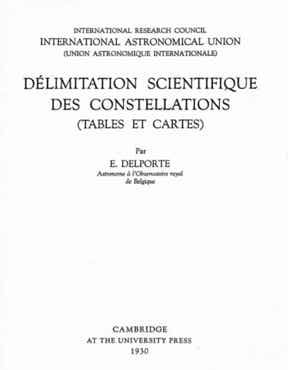
THE introductory text to Délimitation Scientifique des Constellations by Eugène Delporte of the Royal Observatory in Brussels, published by the International Astronomical Union in 1930, was in French. In it he gave the background to the official constellation boundaries that he devised on behalf of the IAU. Here is an English translation.
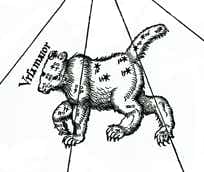
The ancients bequeathed to us, in their descriptions, the starry sky divided into asterisms, but without fixed boundaries. Bode was the first astronomer who, in addition to the symbolic figures, added demarcation lines for the constellations in his celestial atlas; C. L. Harding1 in his Atlas novus coelestis (Göttingen, 1822), retained the boundaries while removing the figures. His successors took considerable liberties with the drawing of these boundaries, which then differed from one atlas to another. An attempt by John Herschel to delimit the constellations in the form of spherical quadrilaterals appeared too radical; his approach moved too many principal stars from one asterism to another. F. Baily, in the preface to the Catalogue of Stars of the British Association (1845),2 laid out a set of rules that, he thought, would provide stable boundaries for the constellations while maintaining sufficient agreement with Ptolemy’s descriptions of the sky. No practical implementation was attempted. Around the same time, Fr[iedrich] Argelander published (1843) his Uranometria Nova.3 The boundaries he assigned to the constellations of the northern hemisphere should have been considered, according to the wish expressed by the Astronomische Gesellschaft in 1867, as accepted without variation. However, subsequent authors of celestial atlases disregarded this wish and it can be said that standard atlases differ significantly from one another, in the boundaries of the constellations and even in their number.
Argelander’s boundaries, moreover, cannot be mathematically defined.
However, the precise delimitation of constellations is of paramount importance for many astronomical tasks, such as the systematic observation of meteors and fireballs, the study and naming of variable stars, the observation of novae, etc.
The work of B. A. Gould (Uranometria Argentina, maps, 1877)4 carried out the reform for the southern hemisphere, the boundaries of the constellations being formed by meridians of right ascension and parallels of declination for the equinox of 1875.0 and, in a few specific cases, by curves as close as possible to great circles of the sphere, and whose position is given by their intersections with meridians and parallels.
In 1923, the Belgian National Astronomy Committee, on the proposal of its President, Professor P. Stroobant, examined the question of revising the boundaries of the constellations in the northern hemisphere. The Congress of the International Astronomical Union, held in Rome in 1922, had already made initial preparations by codifying the abbreviations of 88 constellations that make up the entire sky.
At the request of the Belgian National Astronomy Committee, the matter was placed on the agenda of the Cambridge assembly in 1925. At this meeting, Mr. Delporte presented a preliminary draft resulting from work carried out jointly in Uccle with Mr. Casteels,5 lecturer at the University of Ghent. The General Assembly of the Astronomical Union deemed it useful to revise the boundaries of the constellations in the northern hemisphere and requested that a comprehensive work be presented to it at the Leiden meeting in 1928.
A subcommittee under the Notations Commission (no. 3) was tasked with preparing the work. This work, following the wish of the Variable Stars Commission, was to take into account the already established designations of variable stars and retain these stars within their respective asterisms.
The subcommittee consisted of G. Bigourdan, member of the Institut de France; L. Casteels, lecturer at the University of Ghent (Belgium); E. Delporte, astronomer at the Royal Observatory of Belgium; J. C. Duncan, director of the Whiting Observatory,6 Wellesley, Massachusetts, USA; E. B. Knobel, FRAS, London (England); Miss Mary Proctor, FRAS, London (England); and R. K. Young, Professor of Astronomy at the University of Toronto (Canada).
The starting points, following Mr. Delporte’s proposals, were as follows: To create a scientific delimitation of the constellations of the northern hemisphere, the boundaries being mathematically defined in relation to a specific equinox, these boundaries deviating as little as possible from the undefined outlines found on modern atlases, so as to avoid, as much as possible, moving stars from one constellation to another, and with the express condition of retaining the names already assigned to catalogued variable stars.
To achieve a consistent result, dividing up the delimitation work was not recommended.
Mr. Delporte therefore took charge of the complete theoretical delimitation. As the work progressed, he communicated to the members of the subcommittee, in four reports from October 1925 to the end of September 1927, the results already achieved, asking the members for their opinions, which were taken into account for the rest of the work.
The equinox chosen was 1875.0 to form a whole with Gould's charts for the southern hemisphere.
The outlines are composed solely of arcs of hour circles and parallels of declination. A simple precession calculation, applied to the coordinates of a star, fixes its position within a constellation with absolute certainty. The outline of the constellations follows the contours of the main existing atlases as closely as possible.
All currently named variable stars, which are found in R. Prager’s7 catalogue (Kleinere Veröffentlichungen der Universitätsternwarte zu Berlin-Babelsberg, no. 3, Katalog und Ephemeriden Veränderlicher Sterne für 1928), as well as those included in the latest list published on June 1, 1928, in A.N. no. 5565, Band 232, Naming of Variable Stars, have been taken into consideration. Variables are without exception retained in their constellations.
Once the theoretical delimitation was completed, work on the star charts was also undertaken in Uccle. The desire for complete uniformity led M. Delporte to choose the projection grid adopted by Gould in his Uranometria Argentina. These were therefore reproduced to the same scale.8 The stars are included to magnitude 6.5.
For the final drawing of these charts, Mr. Delporte was assisted by Mr. Coutrez,9 a calculator at the Royal Observatory of Belgium. He is pleased to pay tribute here to the dedication and perseverance of his collaborator, which enabled the project to be completed successfully and on time.
As present circumstances do not allow for the publication of the atlas at the same scale as Gould's, the theoretical delimitation is accompanied by small-scale reproductions of the thirteen charts comprising the whole northern hemisphere. The numbers of the main charts are indicated for each constellation. A fourteenth chart, covering the whole hemisphere, shows the boundaries of the constellations without stars. On this last chart, the indexed meridians and parallels facilitate the task of classifying special stars.
In its current form, the work received approval, at the Leiden Congress in 1928, from the Commissions on Notations (3), Meteors (22), and Variable Stars (27), to whose examination the General Assembly had referred it.
At the Leiden Congress, the desire was expressed to see the boundaries of the southern hemisphere constellations corrected in the areas where Gould had used either obliques or arcs of great circles defined by the coordinates of their extremities.
On the proposal of Mr. Schlesinger, current President of the Notation Commission (No. 3) of the Astronomical Union, Mr. Delporte undertook this correction. Some parallels or meridians used by Gould also had to be changed to include in their respective constellations the following variables: TV Ophiuchi, UW Ophiuchi, DG Aquilae, RR Normae, T Circini, and U Tucanae. The modifications to the boundaries were carried out without the transposition of any star from Gould's catalogue. Charts were also prepared for the southern hemisphere.
Translated and annotated by Ian Ridpath with the assistance of online translators.
Karl Ludwig Harding (1765–1834), University of Göttingen.
Louis Casteels (1881–1965). Casteels had been involved with the Belgian zone of the Carte du Ciel. He was an assistant astronomer at the Royal Observatory in Brussels until October 1923 when he moved to the University of Ghent as a lecturer. Had he not moved he might have played a greater role in the eventual delineation of the constellation boundaries.
This is a mis-spelling. The correct name is Whitin, not Whiting.
Richard Prager (1883–1945) German (later American) astronomer, Berlin-Babelsberg Observatory.
This statement is somewhat misleading. Although the French word reproduits is used in the original text, what is meant is that the charts were originally drawn to the same scale as Gould’s. The final printed reproductions were smaller, as is made clear later in the text.
Gaston Coutrez (1888–1965), Royal Observatory Brussels.